AI in Cybersecurity: 10 Ways Artificial Intelligence Is Changing Cyber Defense
Discover 10 ways AI is transforming cybersecurity, from threat detection and incident response to cloud security, malware detection, and vulnerability management.
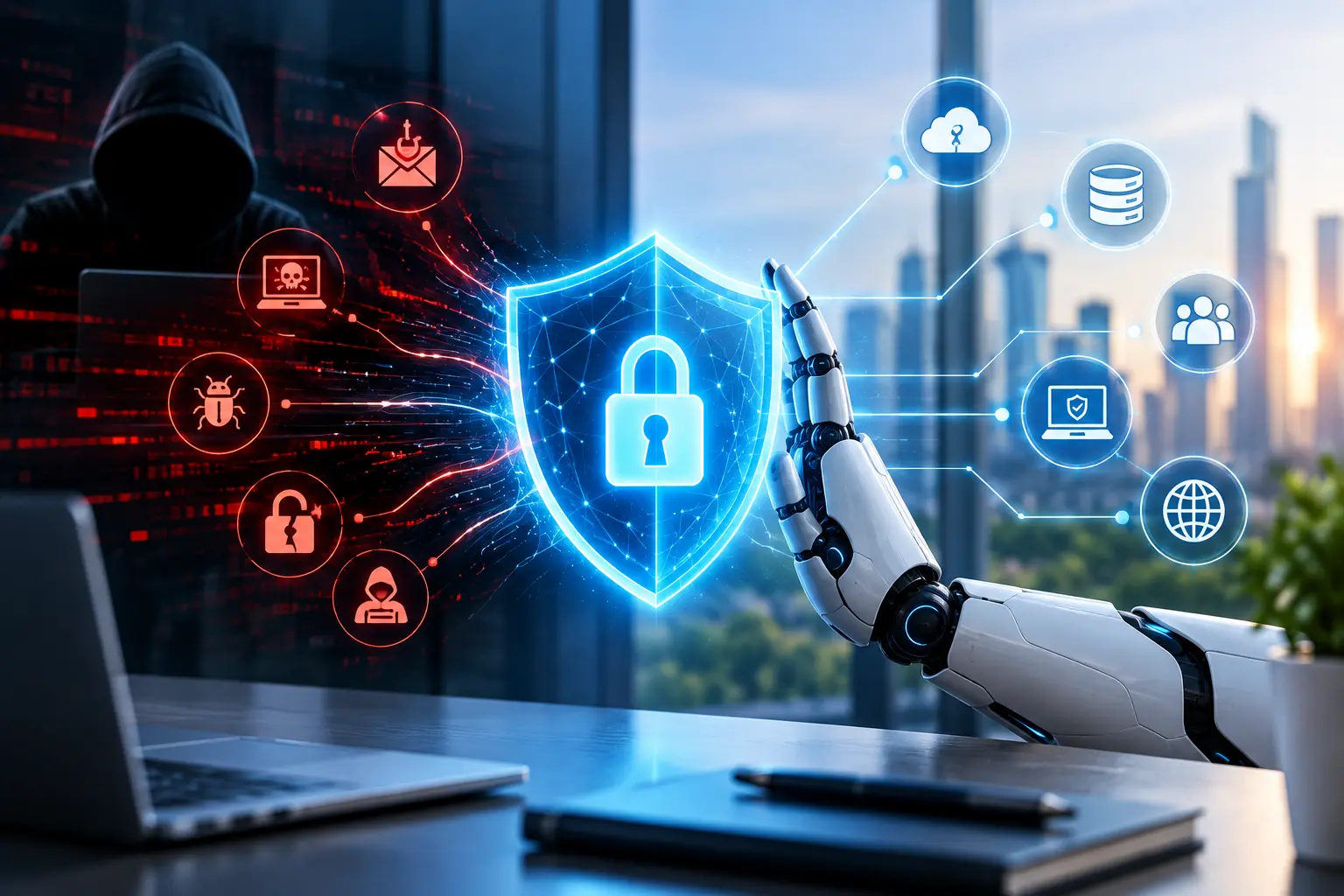
AI in Cybersecurity: 10 Ways Artificial Intelligence Is Changing Cyber Defense
Discover 10 ways AI is transforming cybersecurity, from threat detection and incident response to cloud security, malware detection, and vulnerability management.
Cyber threats are becoming faster, more sophisticated, and increasingly difficult to detect using traditional security methods alone. At the same time, organizations are generating enormous volumes of security data from endpoints, networks, cloud environments, applications, and users.
This is where Artificial Intelligence (AI) in cybersecurity is becoming increasingly important.
Join Webinar about
Practical Training & Job-Oriented Courses
Apply for Upcoming Training Intake
AI and machine learning can help cybersecurity teams analyze large amounts of data, identify unusual behavior, detect potential threats, automate repetitive security tasks, and respond to incidents faster.
But AI is not only helping cybersecurity professionals defend organizations. Cybercriminals are also using AI to make phishing, impersonation, malware, and other attacks more scalable and convincing.
According to IBM's 2026 Cost of a Data Breach research, 26% of malicious breaches in India were AI-generated, highlighting how quickly AI is changing the threat landscape. At the same time, organizations using AI and security automation can reduce breach costs and improve response capabilities.
So, how exactly is AI changing cyber defense?
Let's explore 10 major ways AI is transforming cybersecurity.
What Is AI in Cybersecurity?
AI in cybersecurity refers to the use of artificial intelligence, machine learning, and related technologies to identify, analyze, prevent, and respond to cyber threats.
Traditional cybersecurity systems often rely heavily on predefined rules and known threat signatures. While these approaches remain important, they can struggle with new or rapidly changing attacks.
AI can analyze patterns across huge datasets and identify behavior that may indicate a threat—even when the exact attack has not been seen before.
For example, an AI-powered security system could detect that an employee's account is suddenly:
- Logging in from an unusual location
- Accessing sensitive files it normally never uses
- Downloading an unusually large amount of data
- Attempting to access systems outside its normal role
Individually, these activities might not always trigger a traditional security rule. Together, they could indicate a compromised account.
This ability to identify patterns and anomalies is one of the biggest advantages of AI-powered cybersecurity.
10 Ways AI Is Changing Cyber Defense
1. AI Is Improving Threat Detection
One of the most important applications of AI in cybersecurity is threat detection.
Modern organizations generate massive amounts of security data every day. Security teams cannot manually examine every log, network event, authentication attempt, and endpoint alert.
AI can help analyze this information continuously and identify suspicious patterns.
Machine learning models can learn what normal activity looks like and flag deviations from that behavior.
For example, AI can help identify:
- Unusual login activity
- Suspicious network traffic
- Abnormal file access
- Malware-like behavior
- Privilege escalation
- Unusual data transfers
- Potential insider threats
This can allow security teams to investigate potential incidents earlier.
Why this matters
The earlier an organization detects an attack, the more opportunities it has to contain the damage.
AI therefore acts as an additional layer of intelligence between enormous volumes of raw security data and human cybersecurity professionals.
2. AI Helps Detect Unknown and Emerging Threats
Traditional security tools often depend on known indicators such as malware signatures, malicious IP addresses, or previously identified attack patterns.
But cybercriminals constantly modify their techniques.
This creates a major challenge: How do you detect something you have never seen before?
AI and machine learning can help by identifying behavioral anomalies rather than relying exclusively on known signatures.
Instead of asking:
"Have we seen this exact attack before?"
AI-powered systems can also ask:
"Does this behavior look abnormal or potentially malicious?"
This can be particularly valuable for identifying emerging threats, zero-day attack patterns, and previously unknown forms of malicious activity.
NIST notes that AI can strengthen defensive cybersecurity capabilities while also creating new challenges as attackers adopt AI-enabled techniques.
3. AI Is Transforming Security Operations Centers
A Security Operations Center (SOC) continuously monitors an organization's technology environment for suspicious activity.
SOC analysts may have to deal with thousands of alerts every day.
The problem isn't always a lack of information.
It is often too much information.
AI can help SOC teams by:
- Prioritizing alerts
- Correlating events
- Identifying suspicious patterns
- Summarizing incidents
- Enriching alerts with relevant context
- Recommending investigation steps
- Automating repetitive workflows
This allows security professionals to spend more time investigating high-priority threats instead of manually reviewing every low-risk alert.
For aspiring cybersecurity professionals, this also means understanding AI-powered security operations is becoming an increasingly valuable skill.
4. AI Enables Faster Incident Response
Detecting an attack is only the first step.
Organizations must also respond quickly.
AI-powered security platforms can help automate parts of the incident response process.
Depending on the organization's security architecture, AI can help security teams:
- Identify a suspicious event
- Analyze related activity
- Determine the potential severity
- Identify affected systems
- Recommend containment actions
- Trigger predefined security workflows
- Help analysts investigate the incident
For example, if a system detects suspicious account activity, automated security workflows may temporarily restrict access while a human analyst investigates.
This combination of AI automation + human decision-making can significantly improve response speed.
IBM's research has found that organizations making extensive use of AI and automation in security operations can experience substantially lower breach costs.
5. AI Is Strengthening Malware Detection
Malware continues to evolve.
Attackers can modify malicious code, change delivery mechanisms, and use techniques designed to avoid traditional detection systems.
AI can analyze the behavior of files, applications, and processes to identify potentially malicious activity.
Instead of simply looking for a known malware signature, AI-based systems can examine characteristics such as:
- Process behavior
- File activity
- Network connections
- System changes
- Execution patterns
- Communication with suspicious infrastructure
This behavioral approach can improve an organization's ability to identify suspicious software.
AI can therefore complement traditional antivirus and endpoint security technologies rather than simply replacing them.
6. AI Can Improve Phishing and Social Engineering Detection
Phishing remains one of the most common ways attackers gain access to organizations.
AI can analyze emails, messages, websites, and communication patterns to identify suspicious characteristics.
For example, AI-based security systems may analyze:
- Sender behavior
- Email content
- URLs
- Domain reputation
- Language patterns
- Attachments
- Unusual requests
- Impersonation indicators
This becomes increasingly important as attackers use AI to create more convincing phishing messages.
AI-generated content can make malicious communications appear more natural, personalized, and grammatically accurate.
This creates an ongoing AI vs. AI security battle.
Defenders are using AI to identify suspicious communication while attackers are using AI to improve their social engineering techniques.
7. AI Is Helping Detect Insider Threats
Not every cybersecurity incident starts with an external attacker.
Organizations also need to protect themselves against compromised accounts, accidental data exposure, and potentially malicious insider activity.
AI can help establish behavioral baselines for users.
For example, if an employee normally accesses a limited set of systems during business hours but suddenly:
- Downloads thousands of files
- Accesses highly sensitive databases
- Logs in from an unusual location
- Attempts to access restricted systems
- Transfers large volumes of data
an AI-powered system can identify the unusual pattern and raise an alert.
This doesn't automatically mean the employee is malicious.
Instead, AI provides security teams with a signal that deserves investigation.
Human judgment remains critical when dealing with sensitive employee activity.
8. AI Is Improving Cloud Security
As organizations increasingly move workloads and applications to cloud environments, cloud security has become a critical part of cybersecurity.
AI can help monitor cloud environments for unusual behavior across:
- Cloud accounts
- Applications
- APIs
- Virtual machines
- Storage systems
- Identity and access controls
- Network traffic
AI can also help security teams identify configuration anomalies and suspicious activity across complex cloud infrastructures.
This is particularly important because modern organizations may operate across multiple cloud services and hybrid environments.
The combination of cloud computing + AI + cybersecurity is therefore creating new opportunities for IT professionals with cross-functional skills.
9. AI Helps Automate Vulnerability Management
Organizations may have thousands of applications, systems, devices, and cloud resources that require security monitoring.
Identifying every vulnerability—and deciding which ones deserve immediate attention—can be difficult.
AI can help security teams analyze vulnerabilities and prioritize them based on factors such as:
- Severity
- Exploitability
- Asset importance
- Exposure
- Business impact
- Threat intelligence
- Existing security controls
Instead of treating every vulnerability equally, AI can help organizations focus their resources on the risks that matter most.
This can make vulnerability management more efficient and help security teams move from simply finding vulnerabilities to prioritizing risk.
10. AI Is Creating a New Generation of Cybersecurity Professionals
Perhaps one of the biggest changes caused by AI is not purely technical.
It is changing the skills cybersecurity professionals need.
AI is increasingly being used to automate repetitive tasks, analyze security data, and support investigations.
This means cybersecurity professionals will increasingly need to understand both security fundamentals and AI-driven security tools.
Important skills may include:
- Network security
- Threat detection
- Security monitoring
- Incident response
- Cloud security
- Identity and access management
- Threat intelligence
- Machine learning fundamentals
- AI security
- Security automation
- Risk management
Certifications and hands-on training can also help professionals demonstrate their cybersecurity knowledge.
For professionals looking to build practical cybersecurity expertise, VigyantHub offers cybersecurity training including EC-Council Certified Ethical Hacker (CEH v13) training, alongside its broader cloud and IT certification programs.
AI in Cybersecurity: Benefits and Challenges
AI provides significant advantages, but it is not a magic solution.
Organizations must understand both its benefits and limitations.
Key benefits of AI in cybersecurity
-
Faster threat detection
-
Automated security monitoring
-
Improved anomaly detection
-
Faster incident response
-
Reduced alert fatigue
-
Better vulnerability prioritization
-
Continuous monitoring
-
Improved analysis of large datasets
-
Increased security team efficiency
Key challenges
-
False positives
-
Model bias
-
Data quality issues
-
Privacy concerns
-
AI model attacks
-
Lack of transparency
-
Overreliance on automation
-
AI-powered attacks by cybercriminals
NIST emphasizes that AI creates both defensive opportunities and new cybersecurity and privacy risks, meaning organizations need security practices that address the AI systems themselves as well as the broader environment.
Can AI Replace Cybersecurity Professionals?
No, not completely.
AI can automate many repetitive and data-intensive tasks, but cybersecurity still requires human judgment.
A security professional may need to determine:
- Is this actually an attack?
- What is the business impact?
- Which systems should be isolated?
- Should an account be disabled?
- What evidence needs to be preserved?
- How should the organization respond?
- What security controls need to change?
AI can provide recommendations and accelerate analysis, but humans remain responsible for making critical decisions.
The future of cybersecurity is therefore less about AI replacing cybersecurity professionals and more about cybersecurity professionals learning to work effectively with AI.
AI Is Also Changing the Attacker's Playbook
It is important to remember that AI isn't exclusively a defensive technology.
Cybercriminals can use AI to make attacks faster and more scalable.
Potential uses include:
-
More convincing phishing messages
-
Automated reconnaissance
-
Deepfake impersonation
-
AI-assisted malware development
-
Automated social engineering
-
Faster content generation
-
More personalized scams
IBM's 2026 research found that one in four malicious breaches were AI-enabled globally, representing a significant increase from the previous year.
This means organizations cannot simply adopt AI tools without considering AI-related security risks.
They also need strong governance, access controls, monitoring, and security awareness.
The Future of AI in Cybersecurity
The relationship between AI and cybersecurity will continue to evolve.
Future security operations are likely to combine:
AI + Automation + Threat Intelligence + Human Expertise
AI will increasingly assist security professionals with monitoring, investigation, detection, and response.
At the same time, organizations will need to secure the AI systems they deploy.
This creates an important distinction:
Using AI to secure systems is one challenge. Securing AI systems themselves is another.
Organizations will need to consider issues such as AI access controls, data protection, model security, governance, privacy, and adversarial attacks.
For cybersecurity professionals, this means the ability to understand AI-powered security technologies could become an increasingly valuable career advantage.
Final Thoughts
Artificial Intelligence is changing cybersecurity from reactive defense toward more intelligent, automated, and behavior-based security.
From threat detection and malware analysis to SOC operations, incident response, cloud security, and vulnerability management, AI is helping cybersecurity teams handle threats at a scale that would be difficult to manage manually.
However, AI also gives attackers new capabilities.
The future of cyber defense will therefore depend on organizations using AI responsibly while maintaining strong security fundamentals and human oversight.
For professionals entering or advancing in cybersecurity, the message is clear:
Don't compete with AI. Learn how to work with it.
Develop strong cybersecurity fundamentals, gain hands-on experience, understand modern security tools, and continuously adapt as the threat landscape evolves.
For professionals looking to strengthen their cybersecurity skills and prepare for industry-recognized certifications, explore the cybersecurity learning opportunities available through VigyantHub.

Insights That Shape Better Careers
Modern industries value adaptability, problem-solving, and hands-on experience. Structured learning plays a key role in professional growth.
AI in Cybersecurity: 10 Ways Artificial Intelligence Is Changing Cyber Defense FAQs
Frequently Asked Questions
Welcome back
Our Professional Trending Courses
The most popular picks by professionals, for professionals.

Microsoft Azure Administrator (AZ-104)
Master the skills required to implement, manage, and monitor identity,...

EC-Council Certified Ethical Hacker v13 (CEH v13) Training
The CEH v13 course equips cybersecurity professionals with hands-on skills...

Project Management Professional (PMP)® Training
Master the project management skills required to lead complex projects...

AWS Solution Architect Associate (SAA-C03)
Elevate your career by mastering the ability to design resilient,...